
LESSON 3
How It Captures Your Knowledge
The knowledge extraction isn't a single event — it's a compound effect across four layers that most employees never notice until it's too late.

THE COMPOUND EFFECT
Layer 1 & Layer 2: How Your Input Becomes Training Data
Every question you ask an AI reveals your priorities. Every correction you make provides the most valuable type of data: labeled examples of "right" vs. "wrong."

Layer 1: Prompt Logging
- Mechanism: Every instruction maps your thinking process
- Example: "Summarize focusing on margin trends" reveals what you deem important
- Over time: Hundreds of prompts build a map of your decision framework
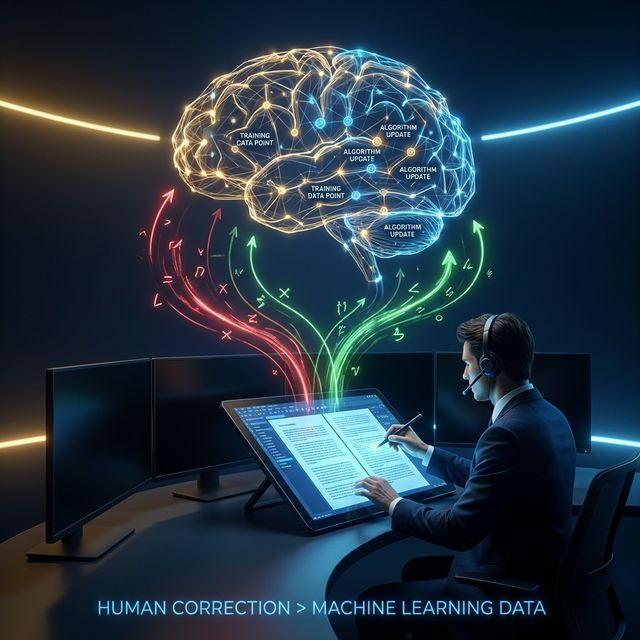
Layer 2: Correction Training
- Mechanism: Your edits are labeled training data
- Example: "Client prefers formal language" teaches style + client preferences
- Value: Corrections are THE most valuable data an AI can receive
THE COMPOUND EFFECT
Layer 3 & Layer 4: The Invisible Capture
Meeting transcription and feedback loops work silently in the background, building an ever-more-complete model of your professional expertise.

Layer 3: Meeting Transcription
- Mechanism: Transcription + action item extraction + expertise ID
- Example: "Sarah seems to be the risk expert" — your role becomes searchable
- Impact: Your knowledge is queryable by anyone in the organization

Layer 4: Feedback Loops
- Mechanism: Every thumbs-up trains a reinforcement model
- Example: Accepting autocomplete codifies your patterns permanently
- Compound: Over 12-18 months → a "partial blueprint" of your judgment
THE BIG PICTURE
12-18 Months of Compound Capture
Each layer alone is benign. Together, they create a digital twin of your professional judgment — not perfect, but close enough to replicate 80% of your routine decisions. That's the threshold where companies start "restructuring."